Bob Cary grew up in Decatur, Michigan, a small village where the shape of life was easy to understand because most of it happened close by.
There was a school, a depot, churches, a downtown, farm country all around, and enough neighbors that a person's name meant something. Decatur was not a place of great distance. It was a place of short errands, familiar roads, railroad schedules, harvest work, school events, and names printed on honor rolls.
That mattered.
Bob came of age in the shadow of the Depression and then under the pressure of a war that kept moving closer to every American town. In a place like Decatur, war was not first experienced as strategy. It was experienced as young men leaving, families waiting, newspaper lists, draft numbers, service flags, and the plain knowledge that ordinary life could be interrupted by events far away.
Family memory says Bob had attended Western before service, and the Western yearbooks now make that memory more concrete. They place him in the student sequence from 1941 through 1943, with spelling variants that have to be handled carefully. They do not yet prove his major or that he graduated. However the exact path unfolded, he belonged to the generation that saw adulthood narrow into a decision: stay with the life that had been planned, or join the country that was already at war.
Bob chose service.
The military took the small-town Michigan boy and put him into one of the most technical, disciplined, and dangerous systems of the war: Army Air Forces medium bombing. He became associated with the B-26 Marauder, a fast twin-engine bomber that demanded respect. Family memory remembered it as a hard airplane, the kind of machine that did not forgive carelessness.
The B-26 shaped men by requiring them to be exact. Takeoff speed mattered. Formation spacing mattered. Weather mattered. Every crewman had a job. Every missed step could become someone else's emergency. A pilot could not succeed by being dramatic. He had to be steady.
That steadiness became part of Bob.
In Europe, Bob's squadron attacked the machinery that kept Germany fighting: rail yards, bridges, ammunition dumps, defensive positions, factories, landing grounds, and supply lines. These were not abstract targets. They were the working parts of a modern industrial war. The mission was to break movement, break production, break supply, and make it harder for German armies to continue.
Bob saw what organized industry could become when it served destruction.
He also saw the human world around it. Family memory places him in France among liberated towns, children, schools, and people who remembered the Americans not as distant aircraft but as living men who had helped end something terrible. One family story remembers a little French girl, Ramon or Ramonde, and a bicycle. Another remembers Bob and Mary later returning to France and seeing children grown into adults.
Those memories matter because they show the other side of the bombing war. The targets were factories and rail lines, but the purpose was people.
When the war in Europe ended, Bob's military life did not stop all at once. Family memory says he returned, married Mary on August 6, 1945, and then went to California because he was apparently headed toward B-29 training for the Pacific war. Then Japan surrendered, and that next war path closed.
The war had carried him away from Michigan. It also hurried him back to what mattered.
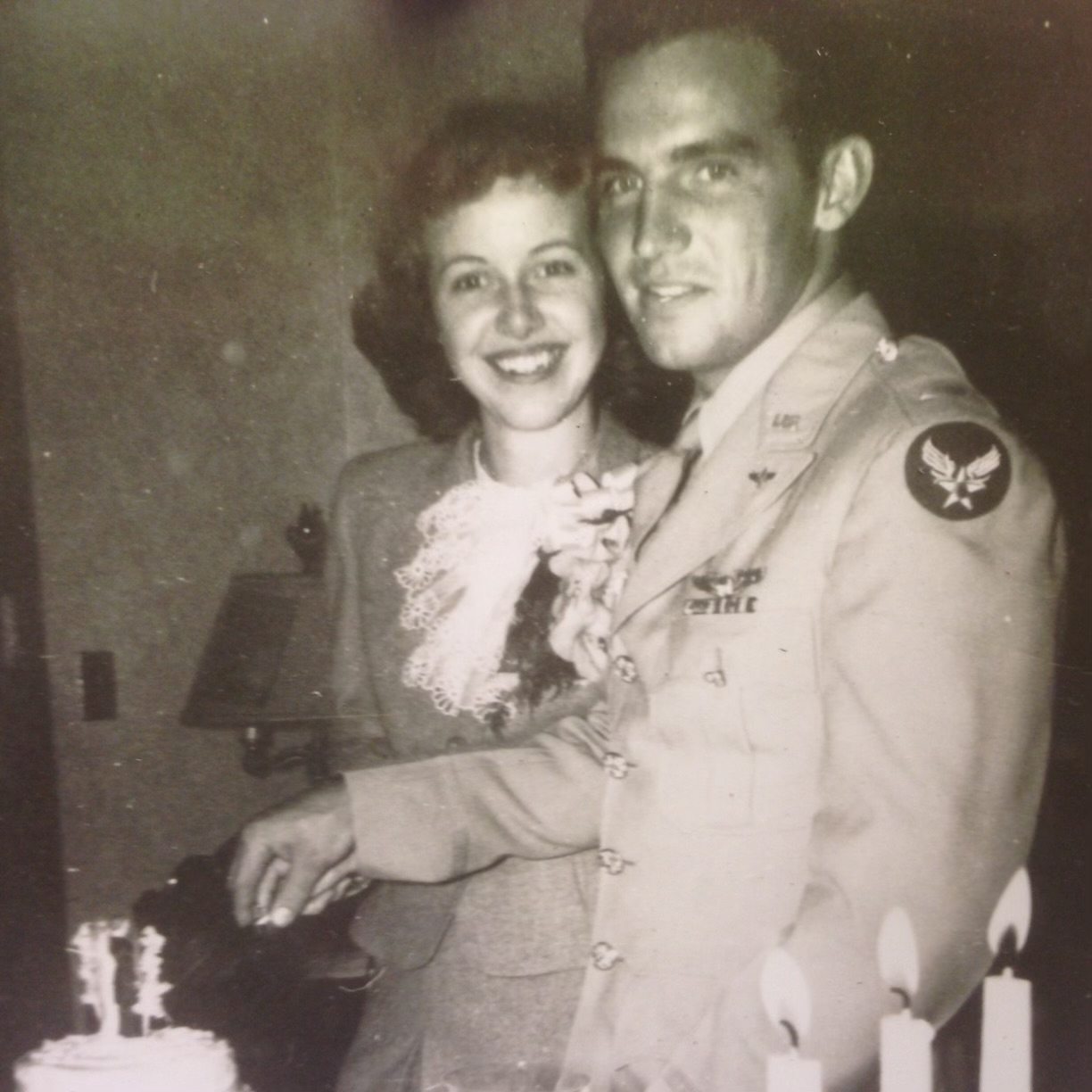
Bob and Mary had known each other through Decatur. The war did not invent that bond, but it gave it urgency. After years of movement, training, danger, and uncertainty, marriage was a decision for home, for future, and for something built to last.
Then came Ann Arbor.
Bob went to the University of Michigan School of Dentistry after the war, and by 1950 he was a D.D.S. That choice makes sense in the arc of his life. He had spent the war inside machines built to damage the enemy's ability to function. Dentistry was almost the opposite calling. It was precise, technical work too, but its purpose was repair. It required calm hands, patience, discipline, and trust from the person sitting in the chair.
The military had taught Bob precision under pressure. Dental school gave that precision a peaceful use.
In 1953, Bob and Mary moved to Hastings, Michigan. Hastings was a small rural town, far from the industrial target maps of Europe. It was a place of patients, church, children, dogs, farm work, and daily duties. Bob bought a farm and raised four children with Mary: Peggy, also known as Margaret; Jeanie; Jim; and Susie.
There is something important in that move.
After bombing the systems of war, Bob did not spend his life chasing the noise of industry or rank or public recognition. He chose a small town. He chose a practice where people came to him one at a time. He chose land, family, church, and work that had to be repeated every day.
The man shaped by military discipline became a dentist, a husband, a father, a farmer, and a steady presence in Hastings. Family memory does not describe him as a man who made much of himself. It remembers a man who kept going. A man who did chores, sang in church, cared about patients, loved dogs, helped people, and taught his children with a phrase that carried the weight of everything he had lived through:
"Don't hustle. Just keep on pluggin'."
That line is the thread through the whole story.
Decatur taught Bob the value of ordinary community. The war showed him what happened when powerful systems were turned toward destruction. The military taught him discipline, precision, endurance, and responsibility for others. Mary gave him a future to return to. Dentistry let him use steady hands for healing. Hastings gave him a place where a life could be built close to the ground.
Bob's life did not erase the war. It answered it.
He came home from machines, targets, and fire, then spent the rest of his years repairing what he could, raising who he loved, and proving in quiet ways that the strongest lives are often built by people who simply keep doing the next good thing.