Back to Bob Cary Research

Timeline

A working timeline that puts Bob Cary's confirmed and likely movements beside the larger war in Europe. The fuller view adds personal milestones that show the life around the service record.

Confirmed record

Bob-specific entries are labeled as confirmed, strong lead, or working assumption. Broader operation notes are context, not proof that Bob personally affected a named operation unless a mission record ties him to that effect. Personal milestones are included as family-history context and stay labeled where details still need primary records.

How to Read This

The mission reports show a pattern: rail bridges, marshalling yards, ammunition sites, defensive areas, and airfields. Those were not random targets. They were part of the Allied effort to restrict German movement, isolate defenses, support ground advances, and prevent late-war reinforcement or evacuation.

Top 5 Timeline Moments

  1. Flight training and replacement path: Bob likely entered the 444th as a late-war replacement airman rather than an original 1942 group member.
  2. Christmas Day 1944: Mission Report 436 confirms Bob Cary as co-pilot in the Singen mission, with the ship 82 drop group still unresolved.
  3. January-February 1945: Cary-linked entries show rail, supply, and weather-frustrated missions during a critical campaign phase.
  4. March-April 1945: Bob appears as pilot on several late-war mission entries as the 320th moved toward the final campaign.
  5. Postwar memory: Bob's Hastings life and the 1980s return-visit trail connect the wartime records to family and local memory.

Jump to a Timeline Phase

Timeline View

Personal 1921 Strong lead

Born Into Southwestern Michigan

Family memory and secondary compiled leads place Bob's birth in 1921. The project treats the exact birth date and birthplace as details still needing primary civil-record confirmation.

Status
Strong biographical lead; primary birth record still needed.
Context
The emerging whole-life frame places Bob in southwestern Michigan, with Decatur becoming the important youth and family-memory setting.
Life lens
The timeline begins in small-town Michigan, not at a bomber base. That makes the later return to Hastings feel like a continuation, not a separate life.
Personal 1940-1943 Confirmed record

Western Michigan Student Years

Family memory said Bob attended Western before service. Western yearbook evidence now supports a sequence from 1941 freshman, to likely 1942 sophomore under the spelling "R. Corey," to 1943 junior as "R. Cary."

Status
Supported by yearbook entries with spelling caveats; graduation and course of study remain unproven.
Context
The 1941 page prints "Robert Carey," while the index lists "Cary, Robert 76." The 1943 page and index give the cleanest Cary form. A 1941 band roster also lists "R. Cary" under Alto Horns.
Life lens
This entry keeps Bob's pre-service life visible before the timeline turns into training, replacement movement, and combat reports.
Personal Before 1945 Strong lead

Bob and Mary Know Each Other Through Decatur

Mary Cary's obituary trail reportedly says Mary met Robert in Decatur before their 1945 marriage. That keeps their relationship rooted in the same small-town Michigan world that shaped Bob before the war.

Status
Strong obituary-based lead; full obituary text and a marriage record would make the details firmer.
Context
Decatur is already a key youth lead for Bob. Mary's connection to Decatur helps bridge the prewar, wartime, and postwar chapters.
Life lens
The war did not create Bob and Mary's bond. It interrupted and intensified a relationship tied to home.
Spring-fall 1943 to 1944 Strong lead

Western to Flight Training Pipeline

The Class 44-F lead places Robert Angus Cary in the Army Air Forces pilot-training pipeline by 1944. Combined with the Western yearbook sequence, the current working estimate is that Bob left normal civilian enrollment sometime from spring through early fall 1943.

Status
Strong timing inference; exact Western withdrawal, aviation-cadet appointment, training fields, and service-entry dates still need records.
Context
By spring 1944 a Class 44-F pilot would likely already have been in basic or advanced flight training, so Bob's normal 1943-1944 senior year was probably interrupted before the 1944 yearbook sequence.
Impact lens
This explains how Western attendance can be true without a proven Western degree: the likely commission path was aviation-cadet training, not college graduation.
6 Jun 1944 Confirmed record

D-Day Elsewhere, 444th in Sardinia

While Allied forces landed in Normandy, Bob's eventual squadron was stationed at Decimomannu Air Base, Sardinia. The 444th's June diary says four of its aircraft took part in bombing the Narni Road Bridge in Italy that day.

Status
Confirmed unit context. Bob's personal location on 6 June 1944 remains unconfirmed.
Context
The 444th station lineage places the squadron at Decimomannu from November 1943 until its September 1944 move to Alto, Corsica. The 320th mission index lists 6 June 1944 as the Narni Road Bridge mission.
Impact lens
This clarifies that Bob's unit story points toward the Mediterranean air war, not the Normandy landing force. Bob may still have been in the training or replacement pipeline.
Oct-early Nov 1944 Confirmed record

Probable Overseas Movement

Best current reconstruction: Bob likely crossed the Atlantic as a late-1944 replacement or possible ferry pilot, not with the original 320th movement in 1942. Family memory points to the United States, the Azores, North Africa, Italy, and then France.

Status
Probable working reconstruction; Bob-specific route still unproven.
Context
AAF route history shows that by 1944 middle-Atlantic routes through Lagens/Lajes in the Azores to North Africa were active, including Wilmington-Newfoundland-Azores-North Africa and Miami-Bermuda-Azores-Casablanca variants.
Impact lens
This fits the Class 44-F replacement pattern and the family memory better than assigning Bob to the original 1942 South Atlantic 320th route.
4 Nov 1944 Confirmed record

Replacements From the States

The 444th Bomb Squadron diary says more replacements arrived from the States on 4 November 1944. Bob may have been in that replacement wave, but the diary does not name him.

Status
Strong unit clue; Bob unconfirmed.
Context
The squadron was still in its Corsica / Italian-campaign phase and was preparing to move to France later that month.
Impact lens
If Bob was among those replacements, a late-October or very-early-November crossing would explain how he could be with the 444th before his confirmed 25 December mission from Dijon.
21-30 Nov 1944 Confirmed record

444th Moves to Dijon

The 444th moved from Alto, Corsica, to Dijon Air Base, France, during November. The diary gives 22 November as the Dijon arrival date and says the air echelon was delayed by weather at Marseilles.

Status
Confirmed unit/base context. Bob is confirmed in the 444th roster, but his exact arrival date is still unknown.
Context
The diary says the squadron set up around Ressey des Citeaux and Chateau de Bessey, and that this move ended its Italian-campaign phase and began operations against Germany itself.
Impact lens
If Bob reached the unit in early November, he likely moved with or near the squadron into France before his confirmed 25 December mission.
16-25 Dec 1944 Confirmed record

Battle of the Bulge Begins

Germany launched its Ardennes counteroffensive on 16 December 1944. While the main battle was farther north, Allied air forces across the theater were under pressure to disrupt movement, supply, and reinforcement routes.

Status
Broader WWII context.
Bob link
The 444th diary notes December precision-bombing work against communications, troop concentrations, and supply dumps.
Impact lens
Rail interdiction missions in Bob's theater could support the larger Allied need to limit German operational mobility during the winter crisis.
25 Dec 1944 Open question

Singen Mission and Thayngen Mistake

Mission Report 436 confirms Cary as co-pilot in 444th ship 82 on the Singen railroad bridge mission. The report says 26 B-26s hit Singen and nine mistakenly bombed Thayngen, Switzerland.

Status
Confirmed Bob mission presence; ship 82 drop group unresolved.
Place
Dijon Air Base to the Singen/Thayngen border area.
Impact lens
The intended target was a rail bridge. A successful bridge strike could slow German rail movement near the Swiss border. The mistaken Thayngen bombing turned the operation into a diplomatic and moral memory that followed veterans for decades.
26 Dec 1944 Confirmed record

Rastatt Railroad Bridge

Cary appears as co-pilot in ship 93 on the Rastatt railroad bridge mission. The report summary says the bridge was missed, though the south approach was cut and bombs landed near the town.

Status
Confirmed Cary-linked mission entry.
Context
The Bulge was still active. Rail bridge attacks remained part of the effort to limit German movement.
Impact lens
Even partial damage to approaches could complicate rail use, but this was not a clean bridge destruction result.
1 Jan 1945 Confirmed record

Transportation Targets as Nordwind Opens

Cary flew as co-pilot with Hartwell Davis on a mission against marshalling yards and a road bridge. Around the same time, Germany opened Operation Nordwind in Alsace and Lorraine.

Status
Confirmed Cary-linked mission entry; broader operation context.
Place
Dijon-based 320th operations against transportation infrastructure.
Impact lens
Marshalling yards and bridges mattered because they moved troops, fuel, ammunition, and repair capacity. The mission type aligns with the Allied need to blunt German winter offensives.
Jan-Feb 1945 Confirmed record

Rail, Supply, and Weather-Frustrated Missions

Cary-linked entries include Achern, Loeffingen, Offenburg, Bad Muenster, Standenbuehl, and Immendingen. Several missions were limited by weather, cloud, target identification, or spare/no-credit status.

Status
Confirmed and partially extracted Cary-linked mission entries.
Context
The Bulge ended in late January. Allied forces were also fighting through Alsace and positioning for the push toward the Rhine.
Impact lens
The targets show the 320th trying to interfere with rail movement and supply flow, but the operational effect varied mission by mission.
19 Jan 1945 Confirmed record

Achern Supply Dump / Chaff Mission

Cary flew as co-pilot in ship 78 with Hartwell Davis on an Achern supply dump and chaff-support mission. Weather and cloud prevented bombing or window/chaff drop.

Status
Confirmed Cary-linked mission entry.
Context
The mission fits the winter pattern of attacking or supporting attacks on German supply and communications targets.
Impact lens
The operational intent was useful, but the weather-limited result shows how winter conditions could block even well-planned tactical air missions.
8 Feb 1945 Confirmed record

Loeffingen Bridge / Lahr Last Resort

Cary again appears as co-pilot with Hartwell Davis, this time on a mission planned against the Loeffingen railroad bridge. The primary was not bombed; the last-resort Lahr target was attacked.

Status
Confirmed Cary-linked mission entry.
Context
Rail bridge interdiction remained central as Allied armies worked toward the Rhine.
Impact lens
The shift to a last-resort target shows how target identification and weather could redirect a mission toward alternate military supply areas.
15 Feb 1945 Confirmed record

Offenburg Marshalling Yard

Cary is linked to an Offenburg marshalling yard mission as co-pilot in ship 98 with Sullivan as pilot. The detailed outcome still needs page-crop extraction.

Status
Cary-linked entry from the mission-log pass; outcome needs direct page-crop extraction.
Context
Marshalling yards were rail sorting and repair nodes, so attacks could interrupt German movement and recovery capacity.
Impact lens
If confirmed in full detail, this event helps show Bob's crew operating against the rail network that sustained German defensive movement.
19 Feb 1945 Confirmed record

Bad Muenster Bridge / Lahr Attack

Cary flew as co-pilot in ship 99 with Ellis as pilot. The primary Bad Muenster bridge and alternate Eppelsheim ammunition dump were not attacked because of weather; Lahr was attacked instead.

Status
Confirmed Cary-linked mission entry.
Context
The mission combined rail-bridge and ammunition-target intent, both relevant to German movement and sustainment.
Impact lens
The actual effect shifted to Lahr, illustrating the 320th's flexibility when weather denied the primary target.
23 Feb 1945 Confirmed record

Standenbuehl Railroad Bridge Spare

Cary appears as co-pilot in ship 98 with Sutherland as pilot, but the row is marked spare and no mission credit.

Status
Confirmed crew-sheet entry; no mission credit for the Cary crew if the spare/no-credit notation stands.
Context
The main mission involved railroad bridge interdiction, with some crews affected by target-identification limits.
Impact lens
This is important because the timeline should show assigned or launched crew activity without overstating combat credit.
24 Feb 1945 Confirmed record

Immendingen Marshalling Yards

Cary is linked to an Immendingen marshalling yards mission as co-pilot in ship 94 with Sutherland as pilot. The exact outcome still needs page-crop extraction.

Status
Cary-linked mission entry; outcome needs page-crop extraction.
Context
Rail-yard attacks helped disrupt the movement, sorting, and repair of trains carrying troops and supplies.
Impact lens
This event adds another rail-network target to Bob's late-winter mission pattern.
12-23 Mar 1945 Confirmed record

From Co-Pilot to Pilot During the Rhine Push

By mid-March, Cary appears as pilot on missions against Siegfried Line defenses, railroad bridges, and ammunition targets. This is the clearest mission-report pattern showing his shift from co-pilot to pilot.

Status
Confirmed Cary-linked mission pattern, though some entries still need page-crop extraction.
Context
U.S. forces seized the Remagen bridge on 7 March, and Allied armies crossed the Rhine in force later that month.
Impact lens
Targets like fortified defenses, bridges, and ammunition storage were directly relevant to breaking German resistance and supporting fast ground movement into Germany.
12 Mar 1945 Confirmed record

Kirkel Ammunition Dump

Cary appears as co-pilot in ship 76 with Hartwell Davis on a Kirkel ammunition dump mission. The mission had mixed results after a BAT malfunction in the lead aircraft.

Status
Confirmed Cary-linked mission entry.
Context
Ammunition dumps were high-value sustainment targets as German forces tried to hold defensive lines west of the Rhine.
Impact lens
The target type connects Bob's crew to the broader effort to degrade German firepower, even though the mission outcome was partial.
16 Mar 1945 Confirmed record

Siegfried Line Defenses

By this point Cary appears as pilot in ship 84, with Browne as co-pilot, on a mission against Siegfried Line defenses east of Zweibruecken.

Status
Cary-linked pilot entry; outcome still needs page-crop extraction.
Context
The Siegfried Line, or Westwall, was the fortified belt Allied ground forces had to break through before the final drive into Germany.
Impact lens
This is one of the clearest points where Bob's target set aligns directly with tactical support to ground forces.
18 Mar 1945 Confirmed record

Weidenthal Railroad Bridge

Cary appears as pilot in ship 91 with Cashen as co-pilot on a Weidenthal railroad bridge mission.

Status
Cary-linked pilot entry; outcome needs page-crop extraction.
Context
Bridge attacks in March 1945 were part of the effort to sever German retreat and reinforcement routes as Allied armies approached and crossed the Rhine.
Impact lens
This entry adds another point showing Bob as aircraft commander during the decisive mobility-interdiction phase.
21 Mar 1945 Confirmed record

Eberstadt Ammunition Factory

Cary appears as pilot in ship 86 with Martley as co-pilot on a mission against the Eberstadt ammunition factory and storage area.

Status
Cary-linked pilot entry; outcome needs page-crop extraction.
Context
By late March, ammunition production and storage targets mattered because German resistance was collapsing but still dangerous.
Impact lens
This target type points to degrading the supply base behind remaining defensive operations.
23 Mar 1945 Confirmed record

Neckarelz Railroad Bridge Spare

Cary appears as pilot in ship 95 with Kercher as co-pilot on a Neckarelz railroad bridge mission, but the entry is marked spare.

Status
Cary-linked pilot entry; likely no mission credit if spare status stands.
Context
The target was part of the Neckar-area rail network at the moment Allied forces were breaking into Germany.
Impact lens
Like the February spare entry, this preserves Bob's assignment pattern without overstating the operational result.
1 Apr 1945 Confirmed record

Move to Dole / Tavaux

The 320th moved from Dijon to Dole/Tavaux around 1 April 1945. Tavaux later became central to family memory, French local evidence, and the 1985 reunion context.

Status
Confirmed unit/base movement; Bob's presence at Tavaux is strongly supported by later photo/reunion leads.
Context
German forces in the west were collapsing after the Rhine crossings, but combat missions continued.
Impact lens
The base move kept the group positioned for late-war targets while also becoming the setting for the human stories remembered after the war.
15-25 Apr 1945 Confirmed record

Late-War Pockets, Ammunition, and Airfield Targets

Cary-linked entries include Ile d'Oleron defenses, Alt Dettelsau ammunition dump, Schussenried landing ground, and Ebenhausen/Benhausen ammunition factory.

Status
Confirmed Cary-linked mission entries, with some mission-credit details still open.
Context
Western Allied forces were advancing rapidly across Germany while some German coastal and rear-area positions still required attack.
Impact lens
These targets suggest final-campaign work: reducing holdouts, destroying ammunition, denying airfields, and preventing organized resistance from surviving the collapse.
15 Apr 1945 Confirmed record

Ile d'Oleron Defense Area

Cary appears as co-pilot in ship 84 with Liebendorfer as pilot on a strike against the Jaffe defense area near Ile d'Oleron on the French Atlantic coast.

Status
Confirmed Cary-linked mission entry.
Context
Even as Germany collapsed inland, fortified coastal pockets in western France still had to be reduced.
Impact lens
This event broadens the timeline beyond rail interdiction, showing Bob's unit supporting the reduction of isolated German positions.
17 Apr 1945 Confirmed record

Alt Dettelsau Ammunition Dump

Cary is documented as pilot in 444th ship 79 on the Alt Dettelsau ammunition dump mission. The report notes explosions and fires, but Cary's spare/early note may affect mission-credit status.

Status
Confirmed Cary-linked pilot entry; mission-credit status needs clarification.
Context
The target was ammunition storage in the final weeks before German surrender.
Impact lens
This entry is useful for Bob's pilot timeline, but it is no longer a Lady Bugs proof point because Lady Bugs is listed as ship 78, not ship 79.
18 Apr 1945 Confirmed record

Schussenried Landing Ground

Cary appears as pilot in ship 76 with Welborn as co-pilot on a mission against the Schussenried landing ground and dispersal areas.

Status
Cary-linked pilot entry; outcome needs page-crop extraction.
Context
Airfield and dispersal-area attacks denied aircraft use, evacuation, or continued Luftwaffe activity late in the war.
Impact lens
The target type shows the 320th shifting from rail and dumps to denial of remaining German aviation infrastructure.
25 Apr 1945 Confirmed record

Ebenhausen / Benhausen Ammunition Factory

Cary appears as pilot in ship 10 with Bailey as co-pilot on a late-war ammunition factory mission. The report snippet says the third squadron bombs landed in an excellent pattern.

Status
Cary-linked pilot entry; exact squadron relation to the reported excellent pattern needs full visual extraction.
Context
The German surrender was less than two weeks away, but ammunition production and storage still mattered to remaining resistance.
Impact lens
This is one of the last currently documented Cary-linked combat entries, tying Bob's timeline to the final collapse of Germany's war capacity.
1-8 May 1945 Confirmed record

Last 320th Mission and V-E Day

The Dole/Tavaux history describes the 320th's last combat mission on 1 May 1945. Germany surrendered in early May, with V-E Day marked on 8 May.

Status
Confirmed unit context; Bob's personal role in the final mission is not confirmed here.
Context
The war in Europe ended, but the 320th later moved toward Germany for disarmament duties.
Impact lens
Bob's documented mission trail sits in the last five months of the European air war, from the winter crisis to the German surrender.
Personal 6 Aug 1945 Confirmed record

Bob and Mary Marry

Family memory says Bob and Mary married on 6 August 1945 after Bob returned from Europe. They then went to California because Bob was apparently headed toward B-29 training or reassignment before Japan's surrender closed that path.

Status
Close-family lead; marriage record, orders, or correspondence would strengthen the details.
Context
V-J Day followed in August 1945. Many service members were still being shifted for the Pacific war when events changed quickly.
Life lens
This is the hinge between wartime service and the home Bob and Mary built afterward.
Personal Late 1940s Confirmed record

Bob and Mary in Ann Arbor

Mary Cary's obituary trail reportedly says Bob and Mary moved to Ann Arbor while Robert attended the University of Michigan School of Dentistry. This places Mary directly inside the transition from war service to a civilian profession.

Status
Strong obituary-based lead; U-M, marriage, residence, or local records could add precision.
Context
The GI Bill era made postwar professional education possible for many veterans, and dental school became Bob's route into a peacetime technical calling.
Life lens
Ann Arbor was not just Bob's education chapter. It was part of Bob and Mary's early married life.
Personal 1950 Confirmed record

University of Michigan D.D.S.

The 1950 Michiganensian lists Robert A. Cary, D.D.S. among University of Michigan dental graduates, supporting the postwar bridge from B-26 service to dental practice.

Status
Strong postwar education lead.
Context
Mary Cary's obituary trail reportedly places Robert and Mary in Ann Arbor while Robert attended dental school.
Life lens
The same steadiness that mattered in formation flying becomes part of a quieter profession built around repair and trust.
Personal 1953 Confirmed record

Bob and Mary Move to Hastings

Mary Cary's obituary trail reportedly says Robert and Mary moved to Hastings in 1953. Public directory leads later associate Robert A. Cary, D.D.S. with a Hastings dental-practice address.

Status
Strong postwar life lead; local newspaper, license, property, or directory records would add detail.
Context
Hastings became the center of Bob's long postwar identity as dentist, husband, father, church member, and farm owner.
Life lens
The move gives the war story its answer: Bob returned to small-town Michigan and built a life around patients, family, land, and daily work.
Personal 1950s-2000s Confirmed record

Practice, Farm, Family, and Church

Family memory remembers Bob in Hastings as a dentist, farmer, husband, father, church member, dog lover, and steady presence. Bob and Mary raised four children: Peggy, Jeanie, Jim, and Susie.

Status
Family-memory and public-story context; exact practice timeline and civic details still need local records.
Context
The postwar years are part of the same biography as the missions, not an afterthought.
Life lens
Bob's remembered phrase, "Don't hustle. Just keep on pluggin'," fits the long daily work of family, patients, farm chores, church, and mission work.
1984-1985 Confirmed record

Return Visits and Memory Work

Swiss and local records connect Hartwell Davis to a 1984 Thayngen return and Bob Cary to a May 1985 return with Davis. Project photo evidence also ties Bob and Davis to the Tavaux reunion context.

Status
Strongly supported by Swiss/local and French book leads; exact article scans still needed.
Context
The wartime operational record became a memory and reconciliation story.
Impact lens
This is where the timeline stops being only about missions. The Singen/Thayngen event appears to have shaped how veterans and local communities remembered the war forty years later.
Personal 1985 Family memory

Bob and Mary Return to France

Family memory says Bob and the 320th returned to France with wives for a 40th-anniversary reunion, and that Bob and Mary later saw French children from the wartime period grown into adults.

Status
Strong family-memory lead aligned with Tavaux reunion evidence; exact pages, captions, and reunion records are still needed.
Context
The Tavaux and Rue Berthelot leads connect wartime base life, French local memory, and postwar reunion photos.
Life lens
Mary belongs in the memory-work chapter too. The return was not only a veteran looking back; it was a family carrying the war story into later life.
Personal 12 Jan 2007 Confirmed record

Bob Dies in Hastings

Dr. Robert A. Cary, D.D.S., of Hastings, Michigan, died on 12 January 2007 at age 85. The obituary trail is one of the postwar anchors tying the wartime Robert A. Cary to the Hastings dentist.

Status
Strong public biographical anchor; full obituary and funeral-home records remain useful proof targets.
Context
By then, Bob's life included war service, dental school, decades in Hastings, marriage, children, church, dogs, patients, and farm work.
Life lens
The fuller timeline shows the B-26 war years as one intense chapter inside a much longer life.
Personal 2016 Confirmed record

Mary's Obituary Preserves the Life Arc

Mary Cary's obituary reportedly preserves key bridge facts: Decatur, the 1945 marriage, Ann Arbor dental school, and the 1953 move to Hastings. It remains one of the most useful postwar sources for connecting the wartime and family-life chapters.

Status
Strong source lead; the project still needs the full obituary text and, ideally, the underlying civil records.
Context
Obituaries often preserve family chronology that official military records omit.
Life lens
Mary's record helps tell Bob's story as a shared life, not only a service file.

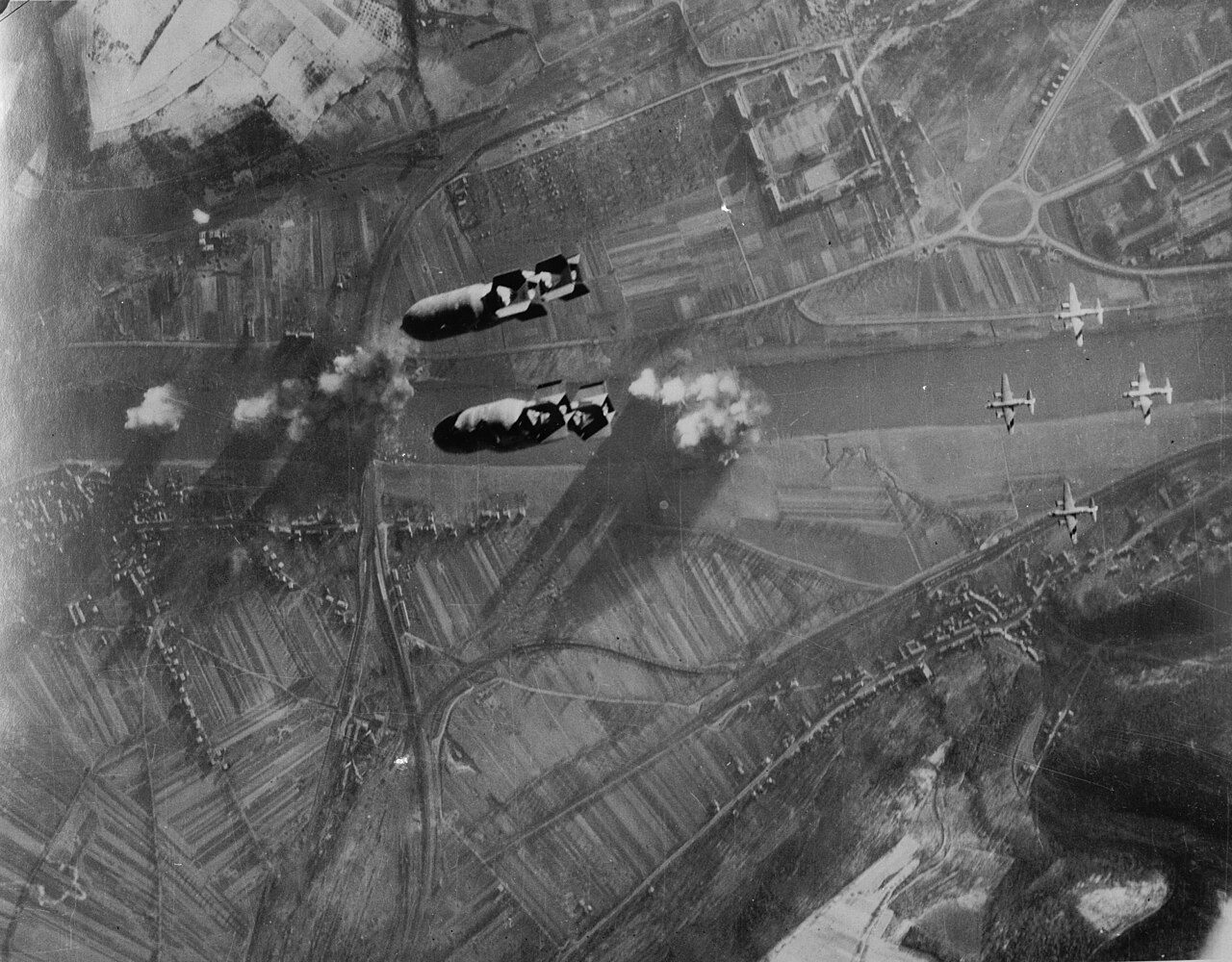
German Rail-Bridge Context Image

USAAF B-26 Marauders attacking the Trier-Pfalzel railroad bridge on 24 December 1944
USAAF B-26 Marauders attacking the Trier-Pfalzel railroad bridge over the Moselle River in Germany, probably on 24 December 1944. This is useful context for the late-1944 rail-bridge campaign one day before Bob Cary's confirmed 25 December Singen mission, but it is not a 320th, 444th, or Bob Cary image. Source: Wikimedia Commons / Library of Congress / USAAF, public domain.

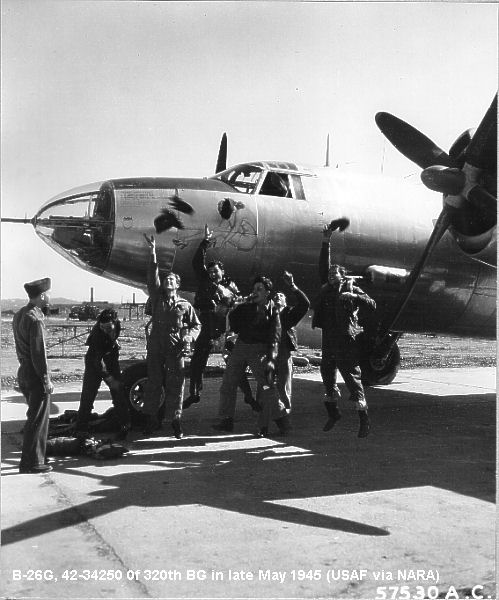
End-of-War Context Image

Members of the 320th Bomb Group tossing caps near a B-26G at the end of World War II
Members of the 320th Bomb Group tossing caps near a B-26G at the end of World War II, late May 1945. Useful as unit-level end-of-war context; this image does not identify Bob Cary. Source: Wikimedia Commons / USAAF via NARA, public domain.

Most Useful Next Proof

The single best timeline improvement would be proof of 444th ship 82's drop group on 25 December 1944. That would show whether Bob's aircraft attacked Singen or was among the nine aircraft that bombed Thayngen.

Context Sources

Research status last reviewed: 8 June 2026.