Identity Confirmed
The casualty card identifies Ronald Marvin Haynes, PFC, USMCR, service number 555802, and matches the Hastings veteran through birth, residence, and next-of-kin details.
World War II family-history project
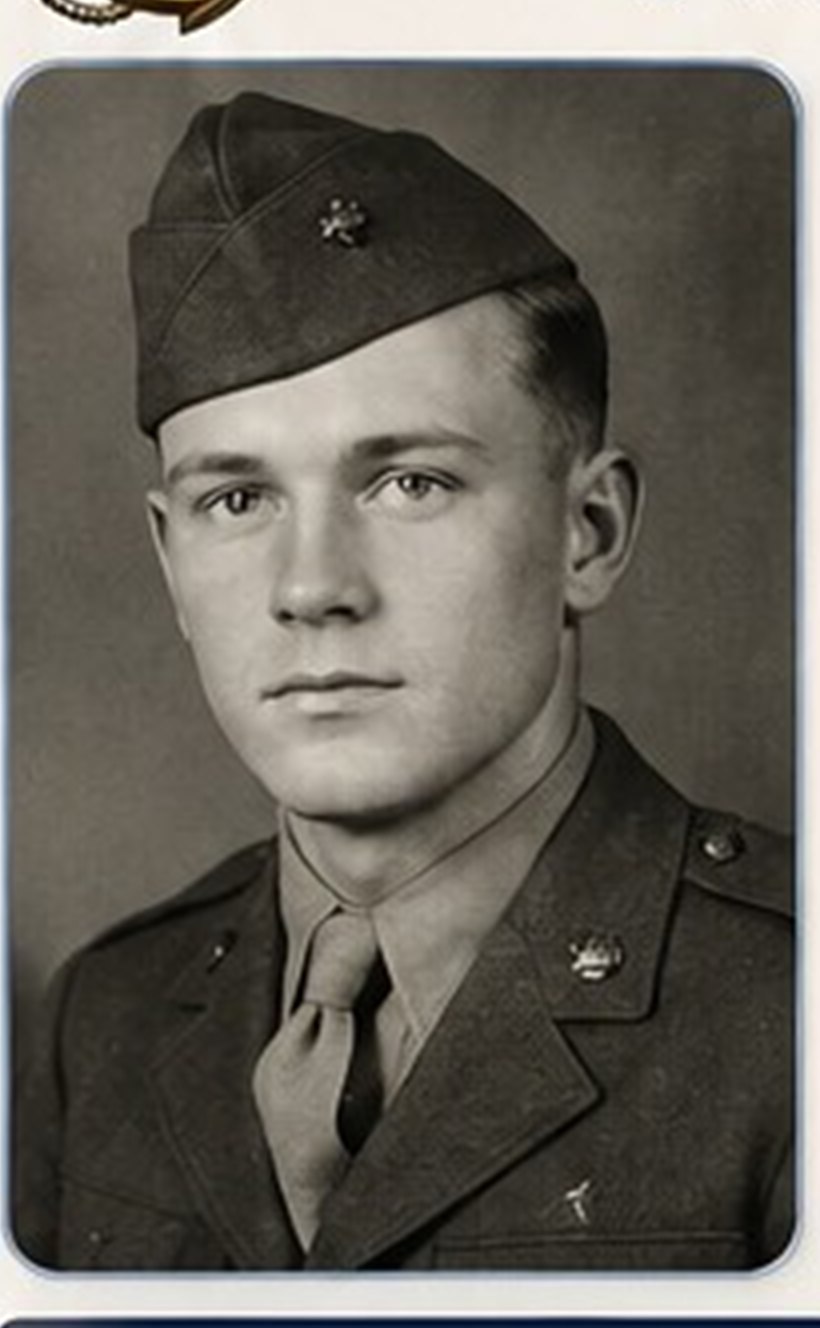
The World War II story of Ronald M. “John” Haynes: a Marine from the Hastings, Michigan, area whose formal service-record name was Ronald Marvin Haynes.
A July 8, 2026 HQMC FOIA release now confirms his identity, service number, 26th Marines connection, and late-February 1945 casualty-card event at Iwo Jima. Family memory and remaining unit and award questions stay clearly labeled.
The casualty card identifies Ronald Marvin Haynes, PFC, USMCR, service number 555802, and matches the Hastings veteran through birth, residence, and next-of-kin details.
The card and public roster now independently support the 26th Marines / 5th Marine Division frame. The card's exact Company B / 3rd Battalion pairing still needs reconciliation.
Family memory says he served as a machine gunner and munitions carrier, fought at Guam and Iwo Jima, helped take Mount Suribachi, and saw both flag raisings.
The card reads “CoB, 3rdBn,” an unusual company/battalion pairing. Muster rolls or his personnel file are still needed before naming an exact company.
The July 8 HQMC response replaces a third-party casualty-card lead with an official record released in full. It confirms the Hastings identity, formal service-record name, service number, Iwo Jima casualty-card event, medical-transfer notation, and return-to-duty status while narrowing the remaining questions.
The card records service number 555802, birth on December 15, 1925 in Grand Rapids, legal residence in Hastings, and matching parents as next of kin.
The card places the event at “Iwo, Volcano Is.” Its front gives February 27; a continuation note records “Combat Fatigue 26Feb45.”
The card records transfer to a base or shore hospital in the Marianas area and an apparent return to duty on March 31, 1945, with favorable prognosis.
The visible wound field is blank and the released card does not establish a Purple Heart. Any award claim still needs a separate official award record.
Ronald M. “John” Haynes of Michigan should not be confused with John Edward “Eddie” Haynes of Utah, a different Marine killed at Iwo Jima with 1st Battalion, 27th Marines.
HQMC FOIA file 2026-USMCFOIA-004602 located one responsive casualty card and released it in full on July 8, 2026. The official card confirms that Ronald Marvin Haynes, service number 555802, is the same Hastings-area Marine remembered by his family as Ronald M. “John” Haynes.
The service number is now confirmed and should be the primary identifier used in future muster-roll, personnel-file, and award searches.
The front is dated February 27, 1945; the continuation says a later casualty report recorded combat fatigue on February 26. Both dates remain preserved as written.
The typed organization line is official card text, but that company/battalion pairing is structurally unusual for the regiment. It is a strong lead, not final company proof.
The card's visible nature-of-wound field is blank. A third-party profile's Purple Heart entry must not be treated as established without separate award evidence.
The route below follows the most likely path if Haynes remained with the 26th Marines. Several points are unit-history reconstructions, not yet individual-service-record proof.
Born December 15, 1925, Haynes grew up near Hastings and graduated from Hastings High School in 1943.
Family memory says he joined the Marine Corps at seventeen. San Diego is a plausible recruit-training location for a Michigan Marine, but not yet confirmed in his record.
The 26th Marines became part of the 5th Marine Division, trained for amphibious assault in California, and later trained at Camp Tarawa on Hawaii’s Big Island.
The likely route ran through Pearl Harbor, rehearsals near Maui and Kahoolawe, Eniwetok, Saipan, and then Iwo Jima, the target known as Island X.
Iwo Jima sat between the Mariana Islands and Japan. Capturing it would remove a Japanese warning and fighter base, support B-29 operations, provide emergency landing fields for damaged bombers, and help secure the approach to Okinawa.
The island gave Japan radar warning, fighter fields, and a forward base from which to threaten American air operations.
American bombers flying from the Marianas needed greater reach, safer recovery options, and reduced Japanese interference.
Once captured, Iwo Jima became an emergency landing field for damaged B-29s that otherwise might have ditched at sea.
The island became part of the final air campaign and the broader campaign pressure leading toward Okinawa and Japan itself.
The table below turns the dossier into public-facing research status. It is intentionally conservative: a claim can be important to the family story and still need a stronger military record before it becomes confirmed history.
| Claim | Current evidence | Status |
|---|---|---|
| Born December 15, 1925; died February 17, 2011 | Girrbach Funeral Home obituary | Confirmed |
| Hastings / Long Lake Cloverdale background and Hastings High School class of 1943 | Obituary and family-history context | Confirmed |
| Ronald Marvin Haynes, PFC, USMCR, service number 555802, served in the 26th Marines, 5th Marine Division | HQMC casualty card plus public 26th Marines roster | Confirmed |
| He was present at Iwo Jima and had a casualty-card event there | HQMC casualty card places the event at Iwo, Volcano Islands; obituary and unit context agree | Confirmed |
| He fought on Guam | Obituary says Guam; 26th Marines history says the regiment was Guam floating reserve and then diverted to Hawaii | Unresolved |
| His exact company and battalion are settled | The official card reads “CoB, 3rdBn,” an unusual pairing; the older 2/26 Company D theory explains the flag-witness memory but is not individual proof | Unresolved |
| Service number 555802 and the late-February 1945 casualty-card event belong to him | HQMC FOIA-released casualty card, matched through birth, residence, and next-of-kin fields | Confirmed |
| The casualty card proves a Purple Heart | The visible nature-of-wound field is blank; no award order, citation, or other official award proof has been located | Not supported by this card |
| The casualty record concerns combat fatigue and later return to duty | Card continuation says “Combat Fatigue 26Feb45”; front records transfer in the Marianas, apparent RTD March 31, and favorable prognosis | Confirmed card text |
| Family memory preserves a blue-and-silver bracelet-like award object | Family recollection; no photograph, marking, paperwork, or official award match yet | Artifact lead |
| He saw the Mount Suribachi flags raised | Family memory plus Company D, 2/26 witness context | Plausible family memory |
| He was one of the flag raisers | No supporting evidence; the known flag raisers were from the 28th Marines and Navy corpsman John Bradley in the first-flag group | Do not claim |
Ronald Marvin Haynes, known to his family as Ronald M. “John” Haynes, was born on December 15, 1925, and grew up near Hastings, Michigan, in the quiet country around Long Lake and Cloverdale. Before he was a Marine, before Iwo Jima, before Mount Suribachi became one of the most famous names in American military history, he was a young man from Barry County who graduated from Hastings High School in 1943.
Family memory says he joined the United States Marine Corps at only seventeen. That detail matters. It places him among the generation of young Americans who left farms, small towns, factories, schools, and families to enter a war already raging across the world. For Haynes, the war would carry him from Michigan to Marine training, across the Pacific, and finally onto the volcanic ash of Iwo Jima.
Several central details are now supported by an official Marine Corps record. The HQMC casualty card identifies him as Ronald Marvin Haynes, PFC, USMCR, service number 555802. Its birth, Hastings residence, and next-of-kin fields connect that formal record name to the veteran his family knew as Ronald M. “John” Haynes. The card and a public 26th Marines roster together establish the 26th Marines, 5th Marine Division frame.
Other details come from family memory and must be treated with care. His obituary states that he served as a machine gunner and munitions carrier, fought at Guam and Iwo Jima, helped take Mount Suribachi, and was present when both flags were raised. The Iwo Jima connection is strongly supported. The exact company and battalion have not yet been confirmed by a muster roll.
The exact company remains open. An earlier working theory placed him with 2nd Battalion, possibly Company D, because that company was positioned to witness the first flag raising. The official casualty card instead types the organization line as “CoB, 3rdBn, 26thMars, 5thMarDiv, FMF.” That is important official-card text, but Company B / 3rd Battalion is structurally unusual for the regiment. The January-March 1945 muster rolls or his personnel file are still needed to reconcile it.
The card also changes how the February 1945 casualty event should be described. Its front gives February 27 and places the event at Iwo, Volcano Islands. A continuation note says a later report recorded “Combat Fatigue 26Feb45.” The visible wound field is blank. The card records transfer to a base or shore hospital in the Marianas area, then an apparent return to duty on March 31 with favorable prognosis. It does not, by itself, prove a Purple Heart.
The likely path from Michigan to combat began with recruit training. For a Marine from Michigan in 1943, San Diego is a plausible training location, although not yet confirmed in his individual record. There, young men were stripped of civilian habits and remade into Marines. They drilled, marched, learned discipline, fired rifles, studied basic tactics, trained with bayonets and grenades, dug fighting positions, and learned the habits of survival expected of infantrymen in the Pacific war.
If Haynes followed the path of the 26th Marines, the next major stop was Camp Pendleton, California. The 26th Marines became part of the newly formed 5th Marine Division, a division created for the final and most brutal phase of the Pacific campaign. The men trained for amphibious assault, landing craft operations, small-unit movement, weapons employment, and the close combat that Marine planners knew would define the coming battles against Japan’s island defenses.
The 26th Marines originally moved west under the shadow of the Guam campaign. This is where family memory and unit history become complicated. Haynes’ obituary says he fought on Guam. The official unit history shows that the 26th Marines was sent west for possible use in the Guam operation, but while the regiment was en route, the situation on Guam changed. The operation was progressing well enough that the additional regiment was no longer needed, and the 26th Marines was diverted to Hawaii.
That means the family memory of Guam may reflect several possibilities. Haynes may have been attached elsewhere before joining the 26th Marines. He may have been part of the force staged and prepared for Guam without actually landing there. Or the memory of his Pacific route may have compressed “sent for Guam” into “fought on Guam.” Until a muster roll or service record confirms the exact sequence, the most honest version is this: family memory placed him at Guam, while the 26th Marines’ official record shows the regiment was prepared for possible use there but diverted before commitment.
In Hawaii, the 5th Marine Division trained at Camp Tarawa on the Big Island. Camp Tarawa was not the tropical paradise men may have imagined when they heard the word Hawaii. It was a rough training ground set in the high ranch country near Kamuela, with dust, lava rock, wind, and cold nights. For Marines preparing to invade a volcanic island fortress, it was useful terrain. It hardened feet, lungs, and tempers.
By late 1944, the division knew its next target only by a code name: Island X. That island was Iwo Jima.
The strategic reason for Iwo Jima was simple to state and terrible to execute. The island sat between the Mariana Islands and the Japanese home islands. By early 1945, American B-29 bombers were flying long missions from bases in the Marianas to strike Japan. Iwo Jima gave Japanese forces radar warning, fighter fields, and a forward base from which to threaten American air operations. If captured, Iwo Jima could serve the United States as an emergency landing field for damaged B-29s, a base for fighter escorts, and a stepping stone in the tightening ring around Japan. It would also help protect the flank of the coming Okinawa campaign.
In other words, the Marines were not being sent to seize black sand and rock for symbolism. They were being sent to remove a Japanese outpost that threatened American bombers and to create a forward base that could save aircrews who otherwise might ditch in the Pacific. The strategic objective was airpower, reach, rescue, and pressure against Japan itself.
For the Marines who would land there, none of that made the beach easier.
The 5th Marine Division moved from Hawaii through the final staging points of the Central Pacific. The assumed route for Haynes, if he remained with the 26th Marines, was from Camp Tarawa to embarkation, then to Pearl Harbor, rehearsals near Maui and Kahoolawe, then across the Pacific through Eniwetok and Saipan. From Saipan, the invasion force sailed toward Iwo Jima.
On the morning of February 19, 1945, the Marines came ashore.
Iwo Jima was unlike the earlier jungle islands many Americans associated with the Pacific war. It was a volcanic fortress. The beaches were made of loose black ash that swallowed boots, bogged down vehicles, and made movement exhausting. The Japanese defenders, under Lieutenant General Tadamichi Kuribayashi, had prepared the island with caves, tunnels, pillboxes, artillery positions, mortars, mines, and interlocking fields of fire. They did not intend to throw the Marines back into the sea in one wild counterattack. They intended to bleed them slowly from hidden positions.
The 26th Marines landed later on D-Day after the first assault waves. By the evening of February 19, the regiment was ashore and moving into the fight. For a machine gunner or ammunition carrier, the battle would have been physical in a way hard to imagine from a map. Machine gun ammunition was heavy. Mortar rounds were heavy. Water was heavy. Everything useful had to be carried forward through loose ash, under fire, through confusion, smoke, shell bursts, screams, and the constant pressure of not knowing where the next round would come from.
Family memory says Haynes was both a machine gunner and a munitions carrier. That combination rings true for the battlefield. A Marine might serve a gun, feed ammunition, haul belts and boxes forward, help move weapons, carry supplies to an exposed platoon, or do whatever the moment demanded. On Iwo Jima, job titles mattered less than survival and momentum. If the gun needed ammunition, someone carried it. If an assault team needed grenades, satchel charges, or belts of machine-gun ammunition, someone moved through fire to bring them forward.
During the first days of the battle, the Marines split their effort. The 28th Marines drove south toward Mount Suribachi, the volcanic cone dominating the southern end of the island. Other elements, including the 26th and 27th Marines, fought northward across the island’s central terrain and toward the airfields and defensive belts beyond.
This is where Haynes’ story touches one of the most famous moments in American history. The actual flag raisers on Mount Suribachi were from the 28th Marines, not the 26th. But Marines of the 26th were close enough to see what happened. A Marine Corps account places Captain Thomas M. Fields of Company D, 2nd Battalion, 26th Marines, in a position where his men saw the first flag go up and shouted for him to look. That account gives weight to the family memory that Haynes saw the flags raised.
The Company D account shows that Marines of the 26th could see the flag rise and supports the plausibility of the family memory. It does not place Haynes in that company, and the casualty card's unusual Company B / 3rd Battalion line keeps his individual position unresolved.
The first flag went up on February 23, 1945. Later, a larger flag was raised, producing Joe Rosenthal’s famous photograph. That image became a national symbol almost immediately. But for the Marines on the island, the flag did not mean the battle was over. It meant the southern landmark had fallen. The killing still lay ahead.
For the 26th Marines, the fight moved north into increasingly savage ground. The regiment fought through terrain where Japanese defenses were dug into caves and ridges, often invisible until they opened fire. Progress was measured in yards. Tanks, artillery, naval gunfire, flamethrowers, bazookas, demolitions, grenades, rifles, and machine guns all became part of the same close fight. The enemy was not simply in front of the Marines. He was below them, beside them, behind them, hidden in tunnels, firing from holes, disappearing, and reappearing.
The fight around Hill 362B became one of the brutal episodes in the 26th Marines’ campaign. By early March, the regiment was deep in the northern struggle. Marines assaulted caves and pillboxes under machine-gun and mortar fire. They used flame and explosives to clear positions that could not be taken by rifle fire alone. Casualties mounted. Units shrank. Companies that had landed with strength were reduced by wounds, exhaustion, and death.
The official card places Haynes at Iwo Jima with the 26th Marines. Family memory describes machine-gun and ammunition-carrying duty, while his exact role and route still await personnel-file or muster-roll support. The regiment's documented campaign extended far beyond the famous view of Suribachi into the grinding northern advance.
That contrast is important. To the public, Iwo Jima often became a single image: six Marines raising a flag. To the men still fighting there, it was a month of attrition. The flag was real. The pride was real. But the island was not won in a moment.
The campaign lasted thirty-six days. Thousands of Marines and sailors were killed. Many more were wounded. The cost was staggering. But the island was taken, and its airfields became part of the final American air campaign against Japan. Damaged B-29s did use Iwo Jima as an emergency landing field. Aircrews who might have been lost at sea had a place to land. Fighter operations gained reach. The Japanese warning and defense network was pushed back.
Ronald Haynes survived. His casualty card records treatment away from the island and an apparent return to duty on March 31, 1945, with a favorable prognosis.
That fact should not be treated as a small thing. Many men in the 5th Marine Division did not come home. Many who did carried Iwo Jima with them for the rest of their lives. Haynes returned to Michigan, to family, to work, and to the long ordinary life that combat veterans often fought quietly to preserve. He married, raised a family, and lived for decades after the war. But the memory of Iwo Jima remained attached to him. Later memorial references remembered him specifically as a United States Marine of World War II and Iwo Jima.
For his family, the story became more than dates and units. It became the story of a seventeen-year-old from Hastings who entered the Marine Corps and served in the Pacific. Family memory describes a machine gunner and ammunition carrier who helped take Mount Suribachi and saw the flags rise over Iwo Jima; those role and location details remain family testimony until individual records confirm them.
The careful historian must still say what remains unconfirmed. His exact company and battalion have not yet been reconciled against muster rolls. The Guam portion of his service remains unresolved. The casualty card does not prove a Purple Heart, and the older 2nd Battalion / Company D flag-witness theory remains contextual rather than individual proof. Muster rolls, his official personnel file, and a separate award verification are now the records most likely to settle those questions.
But the larger story is already clear. Ronald Marvin “John” Haynes left Michigan as a teenager, served as a Marine, and was present at Iwo Jima with the 26th Marines, 5th Marine Division. Family memory supplies the machine-gun and ammunition-carrying details; official records now supply his identity, unit frame, casualty-card event, treatment, and return-to-duty status. The strategic objective was to seize an island that could support the air campaign against Japan and save American aircrews.
He survived Iwo Jima. Because he did, his family can still tell the story.
Marine Corps muster rolls from January through March 1945 would likely confirm his battalion, company, and movement through the Iwo Jima campaign.
Search service number 555802 across Company B / 1st Battalion and the company-level 3rd Battalion rolls to explain the card's unusual organization line.
His service record or discharge paperwork could confirm training locations, units, ranks, dates, awards, and Pacific movements.
Letters, captions, veteran cards, reunion notes, or annotated photographs could identify his company, weapons role, and route.
Local newspaper items, school records, obituary files, and family collections may add prewar, enlistment, or postwar details.
The released casualty card does not establish a Purple Heart. An official award verification, order, citation, or personnel-file entry is still required.
A photograph, markings, paperwork, or family note could clarify whether the remembered bracelet-like object was service jewelry, a souvenir, an identity bracelet, or something else.
Muster rolls before the 26th Marines roster, letters, or movement notes could show whether Guam reflects a prior attachment, a reserve staging memory, or an obituary simplification.
A similar-name Iwo Jima lead points to Private John E. “Eddie” Haynes of Utah, Charlie Company, 1st Battalion, 27th Marines, killed on February 22, 1945. That Marine is not Ronald M. “John” Haynes of the Hastings, Michigan, area.
These are the main source trails now driving the public version of the Haynes research. They do not close every question, but they explain why the page frames the story the way it does.
Casualty card released in full on July 8, 2026, confirming identity, service number, unit frame, Iwo Jima event, combat-fatigue notation, medical transfer, and return-to-duty status.
Identity, dates, Hastings background, Marine service memory, family, and postwar life.
Roster 26th Marines, 5th Marine DivisionPublic roster entry for “Haynes, Ronald M, Pfc.”
Unit history The Spearhead5th Marine Division formation, Camp Tarawa, Guam reserve context, final rehearsals, and Iwo Jima operations.
Marine Corps account Closing In: SuribachiTwo flag raisings, 28th Marines flag-raiser context, and Company D, 2/26 witness lead.
Marine Corps account Closing In: The Drive NorthJapanese defenses, the 26th Marines in the northern fight, ammunition burden, Hill 362B, and B-29 emergency landing context.
Campaign summary VA National Cemetery AdministrationBattle dates, duration, casualty summary, and the airfield rescue value of Iwo Jima.
Next record NARA Marine Corps Muster RollsGuidance for the monthly unit records most likely to prove company assignment.
Earlier public lead Sons of Liberty Museum Casualty Card TranscriptionThird-party transcription that first surfaced service number 555802; its identity lead is now confirmed by the HQMC-released card.
Unverified awards lead Sons of Liberty Museum ProfileLists a Purple Heart entry, but the HQMC casualty card does not prove that award; separate official award evidence is still required.
Official pathway Marine Corps Casualty Card DatabaseOfficial Marine Corps History Division guidance explaining the casualty-card database and record-request path.
Research pathway Marine Corps History DivisionOMPF and monthly accounting record guidance for Marine Corps personnel research.