Status at a glance
- Current version
- Tracks4
- Accepted work
- V4M1–V4M28
- Pending decision
- V4M29 review
- Public runtime
- Not available
The public page is the record, not the application. Tracks4 currently runs as a private local training simulator. No Tracks UI, private backend, live scenario, or hosted pilot is publicly available from dancary.com.
Version history
Each branch preserved a different lesson. Later versions inherit useful ideas without rewriting what the earlier version really was.
-
01
Archived implementation
Tracks1 — the broad prototype
The first full implementation proved the end-to-end training concept in a browser: deterministic simulated scenarios, synthetic sensor observations, fused air and ground tracks, a Cesium 3D view, planning tools, replay, evidence packages, and policy-reviewed human-approved simulated tasking.
Its M0–M23 sequence is complete. The source, tests, scripts, documentation, and local demo profile remain preserved as historical working software. The former temporary public tunnel is gone, and there is no public v1 UI.
M0–M23 complete
Browser/Cesium prototype
Preserved locally
-
02
Historical reference branch
Tracks2 — backend and fusion discipline
Tracks2 rebuilt the project around versioned events, normalized simulated observations, a truth-isolated TrackFusionCore, append-only replay, policy and audit boundaries, exercise authoring, degraded-network rehearsal, lab-scale testing, and local persistence planning.
Spirals 1 through 4 are complete. Spiral 5 stopped after V2S5M1 and V2S5M2; V2S5M3–V2S5M12 remain outlined rather than implemented. Tracks2 is no longer the active branch, but its event, fusion, persistence, replay, and review rules continue to shape later versions.
Spirals 1–4 complete
Spiral 5: 2 of 12 complete
Architecture reference
-
03
Superseded implementation path
Tracks3 — Unreal and governed real places
Tracks3 explored an immersive Unreal Engine operator environment, a backend-to-Unreal bridge, reviewed real-place packages, georeference rules, terrain and topology preparation, source-only track presentation, simulated sensor and camera workflows, and visible policy, approval, audit, and replay context.
Spirals 1 through 3 are complete. Spiral 4 was planned but not started, and this branch never became a standalone runnable backend service. The Unreal critical path was set aside; its interaction, bridge, safety, and place-governance lessons carried into the lighter Tracks4 implementation.
Spirals 1–3 complete
Spiral 4 planned
Unreal path preserved
-
04
Current local implementation
Tracks4 — lightweight browser 3D
Tracks4 keeps the 3D operator experience while replacing the Unreal critical path with a browser client and a small loopback backend. It now has a backend-owned run, imperfect simulated sensing, truth-free fusion, durable recovery and replay, local map context, separately reviewed scenario publication, named local roles, simulated camera cueing, a bounded simulated response action, and two fixed collaboration workspaces.
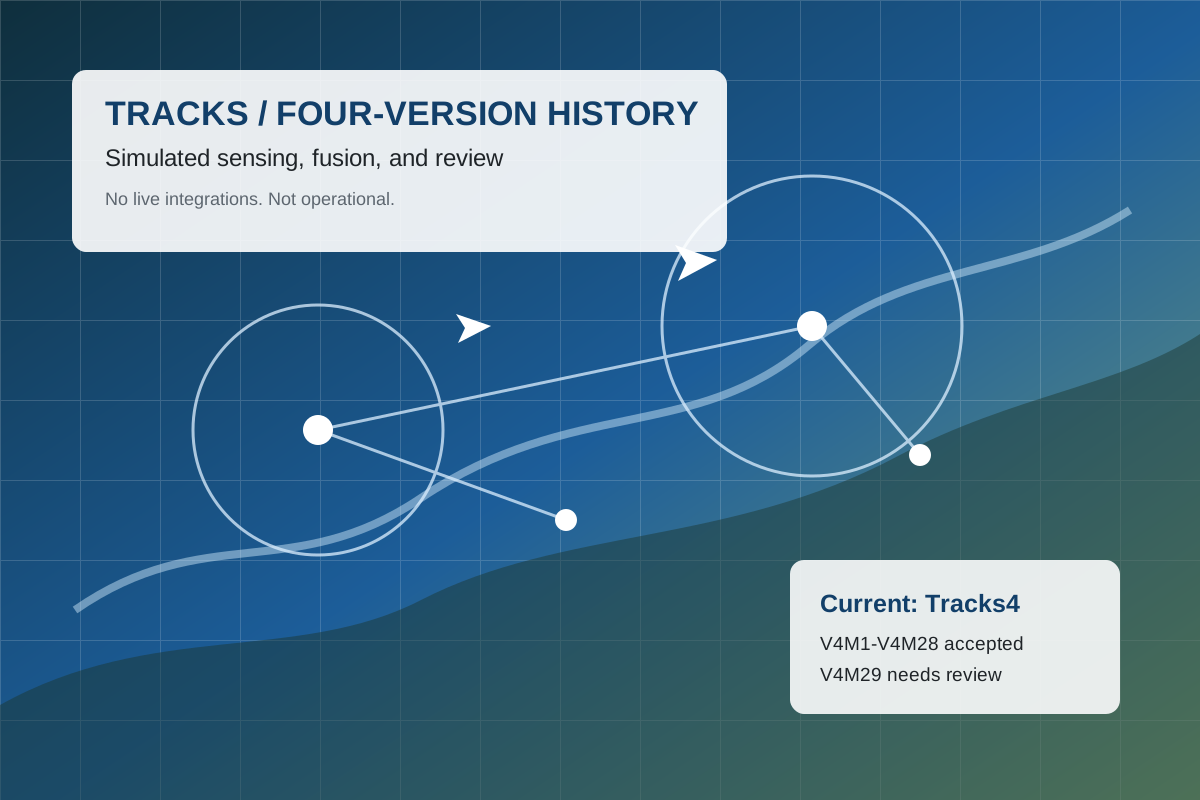
V4M1 through V4M28 and the Q0 integrated assurance gate are accepted. V4M29 has passed its technical, browser-recovery, and resilience evidence but remains needs review; it is not accepted until that decision is made.
V4M1–V4M28 accepted
Q0 accepted
V4M29 needs review
One-line project ledger
| Version |
Role in the history |
Recorded completion |
Public availability |
| Tracks1 |
Original broad browser prototype |
M0–M23 complete |
Archived; no live UI |
| Tracks2 |
Event, fusion, lab, and persistence branch |
Spirals 1–4 complete; Spiral 5 partially implemented |
Historical local source only |
| Tracks3 |
Unreal and real-place architecture branch |
Spirals 1–3 complete; Spiral 4 planned |
Historical local source only |
| Tracks4 |
Current browser-3D implementation |
V4M1–V4M28 accepted; V4M29 needs review |
Private local use only |
The technical through-line
Across all four versions, Tracks is built around the same training problem: help a person reason from incomplete simulated observations instead of handing them perfect object truth.
Items emit signatures
Simulated objects can present acoustic, radar, infrared, RF, visual, vibration, wake, dust, or other scenario-defined cues that change with state and behavior.
Sensors observe uncertainty
Distance, clutter, weather, terrain, line of sight, sensitivity, timing, and noise can weaken, distort, delay, or prevent a simulated observation.
Fusion builds tracks
Repeated observations create tentative and confirmed tracks. Confidence can rise, decay, split, merge, or remain ambiguous without exposing hidden scenario truth.
People retain authority
Planning and simulated actions remain policy-checked, explicitly approved, bounded, logged, replayable, and separated from any real sensor, camera, hardware, or response system.
What happens next
Immediate decision
- Review and either accept or revise V4M29.
- Keep V4M1–V4M28 as the accepted current baseline.
- Preserve Tracks1–Tracks3 as versioned history and design evidence.
Delivery remains future work
- Release, protected staging, public fixture demo, private hosted pilot, and hosted-service hardening remain candidate gates.
- No delivery gate is active while V4M29 awaits review.
- Any future public demo must remain separate from the private simulation backend and use reviewed synthetic fixture data only.
Safety and scope boundary
Every Tracks version is a training and simulation project. Tracks has no live sensor or camera integration, no real response-asset connection, no hardware-control path, no autonomous engagement behavior, and no public sharing of private simulator overlays. Nothing on this page is an operational, fielding, certification, accreditation, or legal-approval claim.